Biome Series
BIOME feels like the next chapter of my artistic ideology – not an abandonment of my earlier works, but a continuation andexpansion of them.
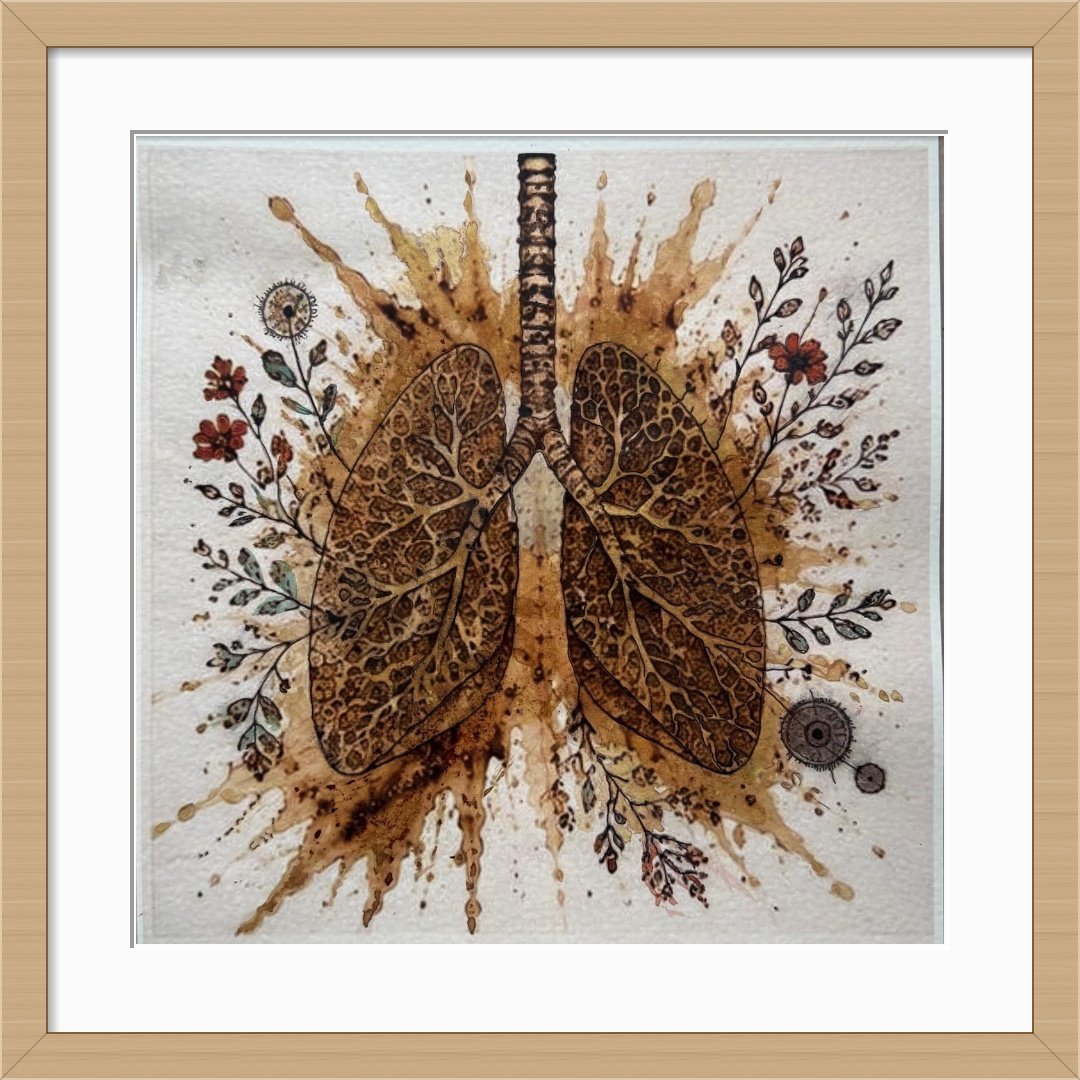
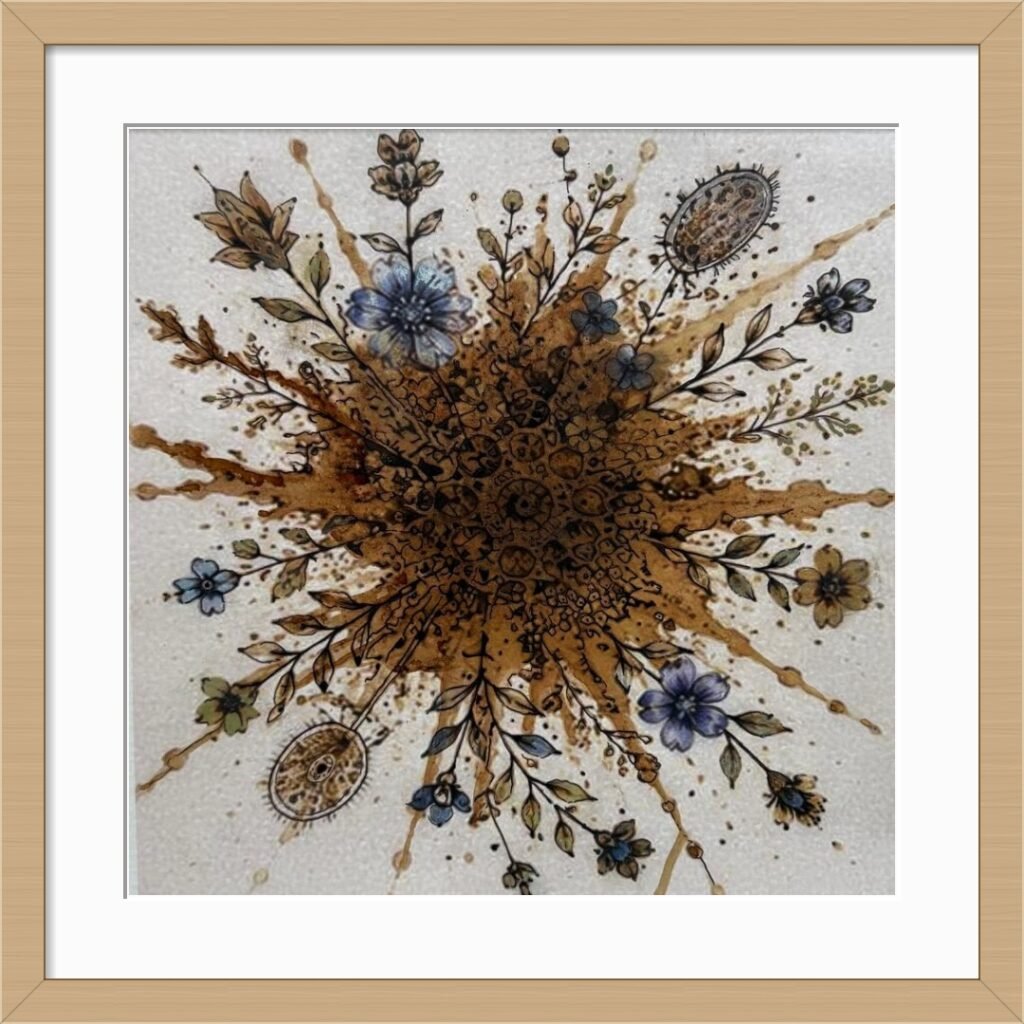
These works sit at the intersection of botany, microbiology, science, and memory. They do not simply decorate biological forms with floral motifs; rather, they suggest that life itself carries an intrinsic impulse towards growth and beauty.
The coffee-stained works feel like an exploration of life. They appear organic rather than accidental, resembling fungal growth, mycelium, vascular networks, or a petri dish in bloom. The marks begin to feel less like deliberate decoration and more
like evidence of a living process.
The cellular patterns anchor the compositions scientifically. They simultaneously recall plant epidermal cells, cork tissue, and bacterial biofilms, leaving the viewer unsure whether they are looking through a microscope or at a landscape.
Whether it is bacterial colonies, plant tissue, molecular structures, or floral forms, these works seem fascinating because nature repeats its language at different scales. A bacterium. A leaf vein. A root system. A vascular bundle. A fungal network. They begin to look like variations of the same visual language.
The delicate botanical linework softens the scientific geometry. Instead of competing with the cellular structures, flowers emerge from them – almost as though evolution itself were flowering.
A restrained palette of muted browns with touches of coral creates a quiet sophistication. The natural tones reinforce the feeling of organic matter, while the coral accents introduce a subtle sense of life and emergence.
The intention is not just to depict beautiful flowers, but to explore the patterns of life. I am interested in the universal patterns that connect all living systems.
The Viewer and Ambiguity
The works invite the viewer to look closely and question what they are seeing. A form might initially appear to be a flower, a bacterial colony, a microscopic organism, a molecular structure, a fungal network, a petri dish, or even a mandala. This ambiguity keeps the eye engaged and allows the image to exist simultaneously at multiple scales.
Every artwork begins with a biological structure – a vascular tissue, neuron,
mitochondrion, fungus, chromosome, or cellular form – which gradually transforms into botanical or floral forms. This process blurs the line between contemporary fine art and scientific illustration.
Curatorial Perspective
The artist investigates the hidden architectures shared by biology and botany. Through mixed media, microscopic cellular structures are layered with delicate floral linework, revealing an unseen continuity between scientific observation and natural ornament.
The works suggest that the same geometry governs roots, networks, flowers, and human imagination. Rather than treating biological structures as purely scientific subjects, the work transforms them into a visual language – one in which cells become patterns, patterns become botanical forms, and botanical forms return to the larger idea of life itself.
I am interested in the universal patterns that connect all living systems