The Invisible Herbarium
My interest gradually changed the way I looked. I began to notice that the extraordinary was not only in biotechnology or futuristic possibilities.
It was already present everywhere—in a cell dividing, a root branching, a fungal network spreading through soil, a bacterial colony multiplying, a leaf carrying water, mitochondria carrying an ancient memory, or two organisms quietly exchanging what each needs to survive.
I began looking closer and the closer I looked, the more the boundaries between things began to disappear.
A microscopic cellular pattern could resemble a landscape.
A root system could resemble a vascular network.
A fungal mycelium could resemble a neural system
Mycelium beneath the soil.
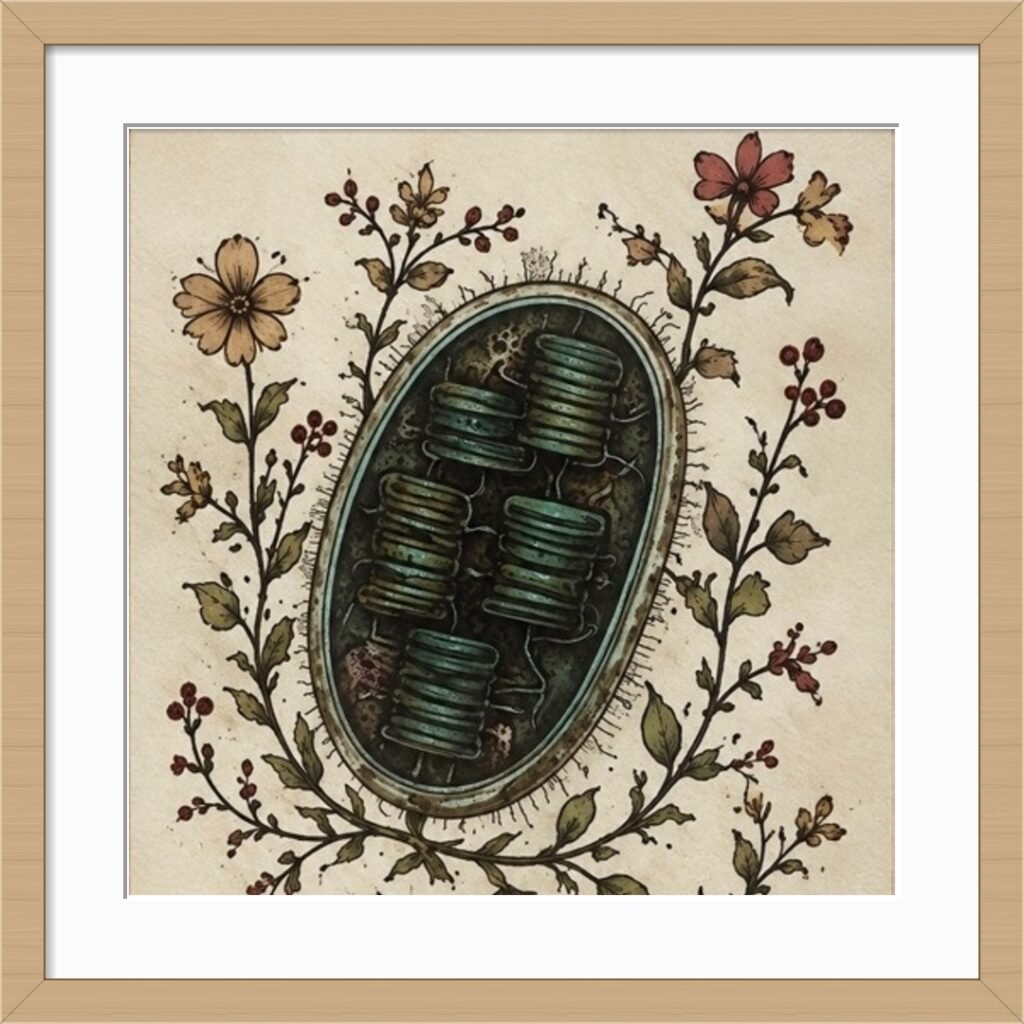
Mitochondria within the cell.
DNA within the nucleus.
Microbes living alongside us.
Networks connecting organisms without being immediately visible.
The invisible becomes a landscape.
And the landscape becomes a biological system.
A botanical motif could begin to look molecular.
A branching evolutionary diagram could become almost ornamental.
The same geometry seemed to keep returning
This is where BIOME begins.
BIOME grows out of this continuing investigation.
It is not an attempt to make scientific illustration into art, nor to decorate biological forms with botanical imagery.
It is an exploration of how nature repeats, transforms, and connects its visual language across scales.
A bacterium.
A leaf vein.
A root system.
A vascular bundle.
A mycelial network.
A chromosome.
A coral colony.
A human body.
Different forms, yet strangely familiar structures.
The work asks
What if these are variations of the same language?
My compositions therefore often begin with a biological structure—a cell, chromosome, vascular system, mitochondrion, fungal network, DNA sequence, or evolutionary pattern—and gradually allow it to transform into botanical, ornamental, or abstract forms. The boundary between scientific diagram and artwork becomes deliberately uncertain.